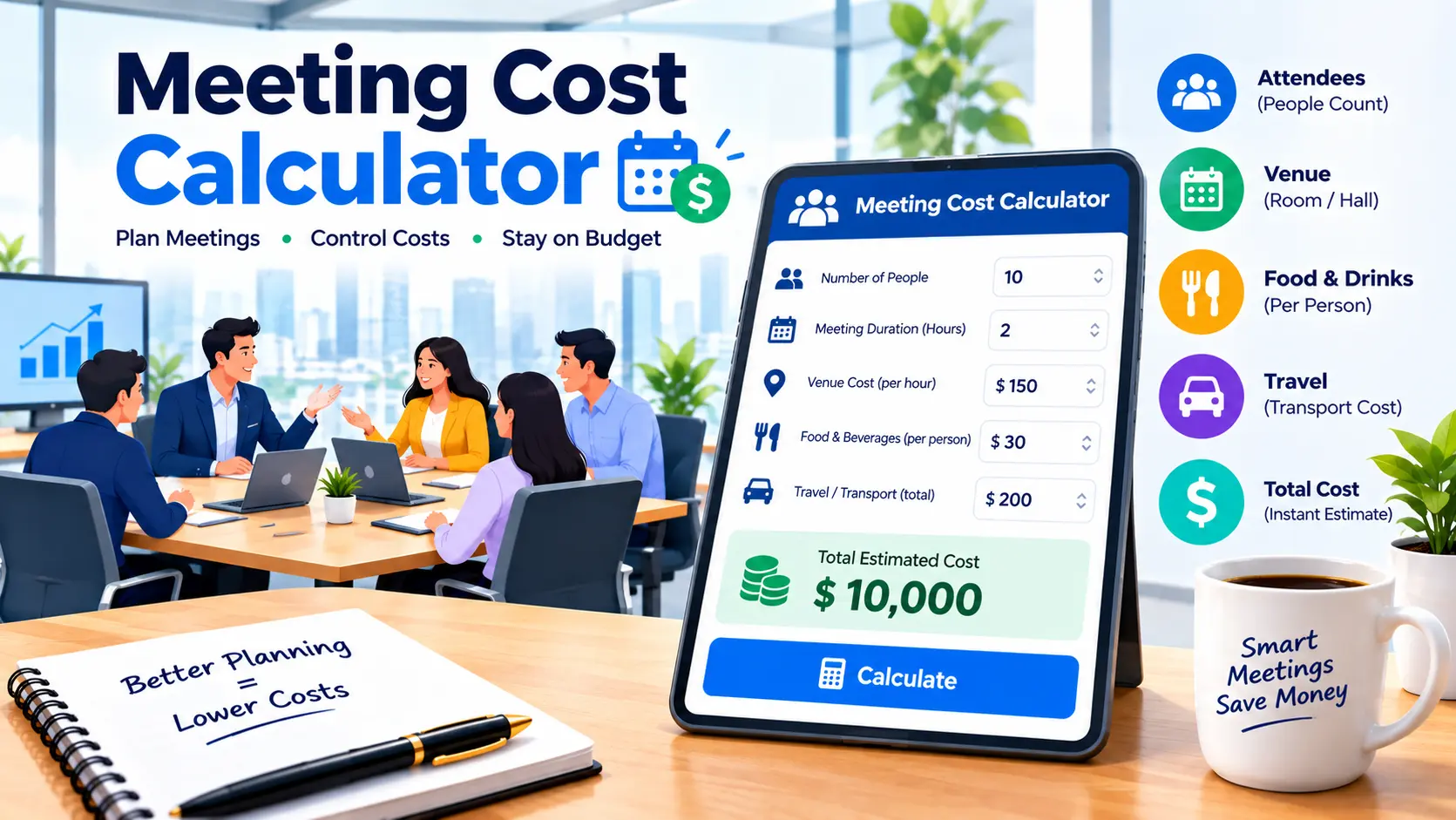
Meeting Cost Calculator
Enter the details below to see the real cost of your meeting — including hidden recovery time. Everything runs in your browser.
Cost breakdown
Why meeting costs matter
Every meeting has a price tag. It's not written on the calendar invite, and it doesn't show up on an invoice, but it's real. It's the combined cost of every person's time in that room — and the time they lose trying to get back to focused work afterward.
The numbers are staggering. Research from Jabra across 2,300 knowledge workers found that 58% of meeting time is considered unnecessary by the people sitting in those meetings, equivalent to 26 working days lost per person per year. A separate study estimates that bad meetings cost enterprises over $130 million annually.
Employees spend an average of 11.3 hours per week in meetings, representing about $29,000 per employee annually at fully-loaded salary rates. When you add hidden costs — context switching, preparation time, and opportunity cost — the true cost is 2 to 3 times higher than direct salary calculations suggest.
A typical 8-person team meeting costs approximately $600 per hour, or $31,200 per year if it recurs weekly. The calculator above shows you the exact number for your meetings.
The meeting cost formula
The basic formula is simple:
Meeting Cost = Number of Attendees × Hourly Rate × Duration (hours)If you only have annual salaries, convert to an hourly rate by dividing by 2,080 working hours per year:
Hourly Rate = Annual Salary ÷ 2,080For example, an $85,000 annual salary becomes $40.87 per hour. But that's just the base salary. The fully-loaded rate — which includes benefits, payroll taxes, and overhead — is typically 1.3× to 1.5× the base rate. At 1.4×, the same employee costs $57.22 per hour.
| Meeting Type | Attendees | Duration | Hourly Cost | Annual Cost (weekly) |
|---|---|---|---|---|
| Daily standup | 4 | 15 min | $200 | $13,000 |
| Team meeting | 8 | 60 min | $600 | $31,200 |
| Sprint planning | 6 | 2 hours | $450 | $35,100 |
| Executive meeting | 6 | 90 min | $900 | $46,800 |
| All-hands | 50 | 60 min | $3,750 | $48,750 |
These figures use fully-loaded rates with benefits and overhead. The annual cost assumes weekly recurrence at 52 meetings per year.
Hidden costs most calculators miss
The direct salary cost is only the beginning. Here's what most meeting cost calculators leave out:
Recovery time (context switching)
Research from Gloria Mark at UC Irvine found that after a meeting, it takes an average of 23 minutes to return to deep focus. That's 23 minutes of lost productivity per person, per meeting — time you're still paying for but not getting back.
For an 8-person meeting, that's 184 minutes — over three hours of lost focus time. The calculator above includes this cost by default.
Preparation time
Most meetings require some prep: reviewing documents, preparing updates, gathering data. That prep time is rarely counted. If each attendee spends 10 minutes preparing for a 60-minute meeting, that's another 80 minutes of salary cost for an 8-person meeting.
Opportunity cost
What could those people have been doing instead? If the meeting is scheduled during peak productivity hours, the opportunity cost is higher than the direct cost. This is hard to quantify, but it's real — and it's why morning meetings are more expensive than late-afternoon ones.
When you include recovery time, preparation, and opportunity cost, the true cost of a meeting is typically 2 to 3 times the direct salary calculation. The calculator gives you a conservative estimate with just recovery time included — the real number is likely higher.
What's a normal meeting cost?
The average meeting costs between $338 and $1,500 per hour depending on attendees and seniority levels. Here's how to read your own number:
| Range | Verdict | What it means |
|---|---|---|
| Under $150/hr | Low | Small team, short meeting. This is fine — just make it count. |
| $150–$500/hr | Moderate | Normal for a team sync. Ask: does everyone need to be here? |
| $500–$1,000/hr | High | Senior attendees or large group. Could this be async, or a smaller group? |
| Over $1,000/hr | Critical | Expensive meeting. Justify it. Could it be an email or a document? |
These benchmarks are for a single meeting hour. Multiply by the recurrence to see the annual impact — a $600/hour meeting that runs weekly costs $31,200/year.
How to reduce meeting costs
1. Cut the invite list
Every person you remove from a meeting saves their full hourly rate for the duration. An 8-person meeting at $57/hr costs $456/hour. Removing two people saves $114/hour — $5,928/year for a weekly meeting. Ask: who truly needs to be here?
2. Shorten the meeting
A 60-minute meeting costs twice as much as a 30-minute meeting. If you can achieve the same outcome in 30 minutes, you've just halved your cost. Try defaulting to 25 or 50 minutes instead of 30 or 60 — the shorter duration forces focus.
3. Question the recurrence
A weekly meeting that could be monthly saves 40 meetings per year. A daily standup that could be async saves 260 meetings per year. The annual cost of recurring meetings is where the real money is.
4. Make meetings smaller and faster
Consider whether the meeting could be:
- An email — for status updates, no discussion needed.
- A shared document — for review and feedback.
- A async video — for one-way information sharing.
- A smaller pre-meeting — get the decision-makers together, then broadcast the outcome.
See what your meetings really cost — free, private, browser-only
The meeting cost checklist
- Run the numbers first. Use the calculator above before you send the invite.
- Ask who really needs to be there. Remove anyone who doesn't.
- Set the shortest duration possible. Default to 25 or 50 minutes, not 30 or 60.
- Question the recurrence. Does this need to be weekly, or would monthly work?
- Include recovery time. Add 23 minutes per person to your estimate.
- Make every meeting earn its place. If it costs $600/hour, it should produce $600+ of value.